
When pain refuses to go away, it is natural to wonder how far treatment needs to go.
Does persistent back pain eventually mean surgery?
Does a damaged joint automatically require an operation?
Or are there other options worth trying first?
The answer is not as simple as choosing between surgery and doing nothing. Pain can have many different causes, and treatment needs to match the underlying problem.
In many situations, conservative care can play an important role in reducing symptoms, improving movement, and restoring function. In others, surgery may be appropriate or even necessary.
The key is understanding your options. A personalized pain management Fremont approach can help you explore non-surgical treatments and determine when further medical evaluation may be appropriate.
Is Surgery Always the Last Option for Pain?
No. Surgery is not automatically the last option for every painful condition.
Some conditions may improve with conservative treatment, while others may eventually require surgery. The decision depends on factors such as the underlying diagnosis, severity of symptoms, functional limitations, previous treatment, overall health, and whether there is structural damage that needs to be addressed.
For some people, surgery may be recommended early because delaying it could create additional problems. For others, non-surgical treatment may be a reasonable first step.
That is why the goal should not simply be to avoid surgery at all costs. It should be to choose the most appropriate treatment for the individual situation.
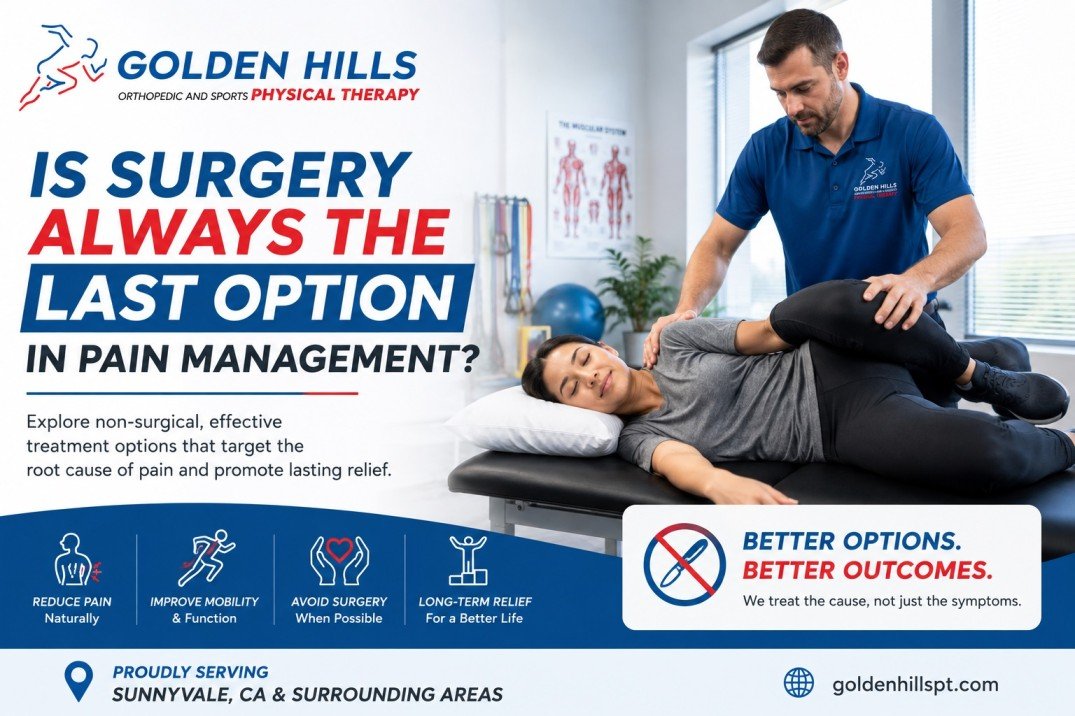
What Non-Surgical Pain Management Options Are Available?
1. Physical Therapy
Physical therapy is commonly used to address pain while improving strength, mobility, flexibility, balance, and movement.
Rather than focusing only on where the pain occurs, a physical therapist may assess how you move and whether weakness, stiffness, muscle imbalance, or movement limitations are contributing to your symptoms.
A personalized exercise program can then be progressed as your tolerance and function improve.
2. Exercise and Movement
Pain can sometimes lead people to stop moving altogether. However, prolonged inactivity may contribute to weakness, stiffness, and reduced physical capacity.
The right type and amount of exercise depends on the condition. A structured program can help you gradually build strength and confidence without unnecessarily aggravating symptoms.
3. Activity Modification
Sometimes the problem is not movement itself but doing too much of a particular activity.
Changing how you lift, sit, exercise, work, or perform repetitive movements may help reduce stress on painful areas.
A physical therapist can help identify activities that may need modification while keeping you as active as reasonably possible.
4. Medication
Depending on the type and cause of pain, a healthcare professional may recommend medication as part of a broader treatment plan.
Medication decisions should be individualized, particularly for persistent pain or when other medications and health conditions are involved.
5. Education and Self-Management
Understanding your pain can change how you approach recovery.
A healthcare professional can explain what may be contributing to your symptoms, which activities are appropriate, and how to manage flare-ups.
Learning how to manage symptoms can be particularly important when dealing with long-term or recurring pain.
When Might Surgery Be Considered?
Surgery may become an option when there is a specific structural problem that requires correction, when symptoms are severe, or when appropriate conservative treatment has not provided enough improvement.
The exact circumstances vary significantly depending on the condition.
For example, someone with a serious injury or progressive neurological symptoms may need a different approach from someone experiencing uncomplicated muscular pain.
A medical evaluation is essential before deciding whether surgery is appropriate.
How Do You Know If Non-Surgical Treatment Is Worth Trying?
-
Your Pain Is Affecting Daily Activities
If pain is making it difficult to walk, work, exercise, sleep, or perform everyday activities, professional assessment can help identify potential treatment options.
-
Your Symptoms Are Persistent
Pain that continues despite your usual self-care may deserve a more detailed evaluation.
A professional can look beyond temporary symptom relief and consider factors contributing to the problem.
-
You Want to Improve Strength and Movement
If weakness, stiffness, balance problems, or reduced mobility are contributing to your limitations, physical therapy may be useful as part of a broader treatment plan.
-
You Have Not Tried Structured Rehabilitation
There is a difference between simply resting and following a structured rehabilitation program.
A personalized pain management Fremont program can target specific limitations and gradually increase the demands placed on your body.
Can Pain Management Help You Avoid Surgery?
In some cases, non-surgical treatment may improve symptoms and function enough that surgery is not needed. However, this cannot be guaranteed.
The purpose of conservative treatment is not to promise that surgery can always be avoided. Instead, it provides an opportunity to address pain and functional limitations using appropriate non-surgical approaches when clinically suitable.
If surgery is eventually recommended, physical therapy may still have a role before or after the procedure, depending on the condition and medical advice.
What Factors Influence the Treatment Decision?
-
The Cause of Your Pain
Pain caused by muscle weakness may require a very different approach from pain caused by a structural injury or nerve problem. Identifying the underlying cause is therefore an important first step.
-
How Long You Have Had Symptoms
Acute pain and persistent pain may require different management strategies. Your treatment plan should reflect the duration and pattern of your symptoms.
-
Your Functional Limitations
The impact of pain on your ability to work, exercise, sleep, walk, or perform daily activities matters when determining treatment goals.
-
Your Response to Previous Treatment
If you have already tried medication, rest, exercise, or physical therapy, your response to those treatments can help guide what should happen next.
-
Your Overall Health and Goals
Treatment should also consider your general health, activity level, lifestyle, and personal goals.
For an athlete, returning to sport may be the priority. For another person, being able to walk comfortably or complete household activities may be the main goal.
Why a Personalized Approach Matters
Pain is not one-size-fits-all.
Two people can have similar symptoms but completely different causes and treatment needs. This is why copying someone else’s exercises or relying solely on generic online advice may not provide the right solution.
A professional assessment can help identify your specific limitations and establish realistic treatment goals.
When Should You Seek Medical Evaluation for Pain?
Persistent pain should not always be managed through self-treatment alone.
Seek prompt medical attention for severe or rapidly worsening pain, significant weakness, loss of sensation, major trauma, new problems with bladder or bowel control, or other concerning symptoms.
For ongoing pain that is interfering with daily activities, exercise, sleep, or work, a healthcare professional can help determine whether further evaluation or treatment is appropriate.
Personalized Pain Management at Golden Hills Physical Therapy
Surgery can be an important treatment option when it is medically appropriate, but persistent pain does not automatically mean an operation is the next step. Depending on the cause and severity of your symptoms, non-surgical approaches such as physical therapy, targeted exercise, activity modification, and other treatments may have an important role.
The most useful question is not simply, “Can I avoid surgery?” It is “What treatment is appropriate for my condition and goals?”
At Golden Hills Physical Therapy, our goal is to help patients improve movement, manage pain, and work towards better physical function through personalized rehabilitation.
We personalize treatment plans according to an individual’s condition, lifestyle, and goals rather than relying on a one-size-fits-all approach.
If ongoing pain is affecting how you move, exercise, work, or enjoy everyday activities,we can help you explore appropriate physical therapy and pain management Fremont options.
Book an assessment to understand your symptoms and take a structured step towards better movement and function.
FAQs
Is surgery always necessary for chronic pain?
No. Some chronic pain conditions can be managed with non-surgical approaches such as physical therapy, exercise, activity modification, medication, and other treatments. Whether surgery is appropriate depends on the underlying condition.
Can physical therapy help with pain without surgery?
Yes. Physical therapy may help improve strength, mobility, movement, and physical function while reducing pain for certain conditions. Your treatment plan depends on the cause and severity of your symptoms.
How long should I try conservative treatment before considering surgery?
There is no universal timeframe. It depends on the diagnosis, severity of symptoms, functional limitations, response to treatment, and medical recommendations.
Can physical therapy prevent surgery?
In some cases, effective rehabilitation may improve symptoms and function enough that surgery is not necessary. However, physical therapy cannot replace surgery when a surgical procedure is medically required.
What is the difference between pain management and surgery?
Pain management generally focuses on reducing symptoms, improving function, and addressing contributing factors through non-surgical or conservative approaches. Surgery physically corrects certain structural problems when an operation is considered appropriate.
Should I avoid surgery if possible?
Surgery should not be viewed as either inherently good or bad. If it is medically necessary, avoiding it may not be appropriate. The best approach is to discuss the risks, benefits, alternatives, and expected outcomes with the relevant healthcare professionals.
Can I start physical therapy before seeing a surgeon?
Depending on your symptoms and diagnosis, physical therapy may be appropriate before surgical consultation. However, some injuries or medical conditions require prompt medical evaluation first.
What types of pain can physical therapy help manage?
Physical therapy may be used as part of treatment for various musculoskeletal conditions affecting areas such as the back, neck, shoulders, hips, knees, and other parts of the body. The suitability of therapy depends on the underlying cause.
When should pain be evaluated by a healthcare professional?
Consider professional evaluation when pain persists, repeatedly returns, limits normal activities, affects sleep or exercise, or is accompanied by weakness, numbness, swelling, or other concerning symptoms.
Can pain come back after physical therapy?
Pain can sometimes return depending on the underlying condition, activity levels, contributing factors, and other circumstances.
Your physical therapist can help you develop strategies to maintain strength, mobility, and function after your initial rehabilitation.
